


Guided Pathways
- An equity-focused approach that provides clear academic and career pathways to help students choose, plan and complete their goals.
- Focuses on removing systemic barriers and redesigning college practices to better serve historically underserved students.
- Tied to the Chancellors Office broader goals like Vision 2030, aligning student experience redesign with statewide priorities for completion, equity and workforce outcomes
Guided Pathways Framework
The Guided Pathways Framework consist of four pillars: Clarify the Path, Enter the Path, Stay on the Path, Ensure Learning. Descriptions are from the Guided Pathways website by the Chancellor's Office:
- Clarify the path – Provide clear program maps and course sequences aligned with student goals
- Enter the path – Support students in choosing and beginning a program of study early
- Stay on the path – Provide integrated academic and non-academic supports to sustain progress
- Ensure learning – Ensure that students achieve learning outcomes and workforce competencies
The Guided Pathways framework aims to redesign the student experience to create clear academic and career paths by removing systemic barriers so that all students, particularly underserved populations, can succeed (Chancellor's Office website, 2026).
A Race-Conscious Approach
The Guided Pathways work at SMC aims to center a race-conscious approach to ensure that we remove or minimize institutional barriers that hinder the success of our marginalized student populations, especially our Black and Latine students. However, the Guided Pathways framework can potentially be implemented without race-consciousness. The image below frames how one may approach the Guided Pathways work at the college: race-conscious, race-neutral, or deficit-oriented (image courtesy of Hannah Lawler, former Dean of Institutional Research).
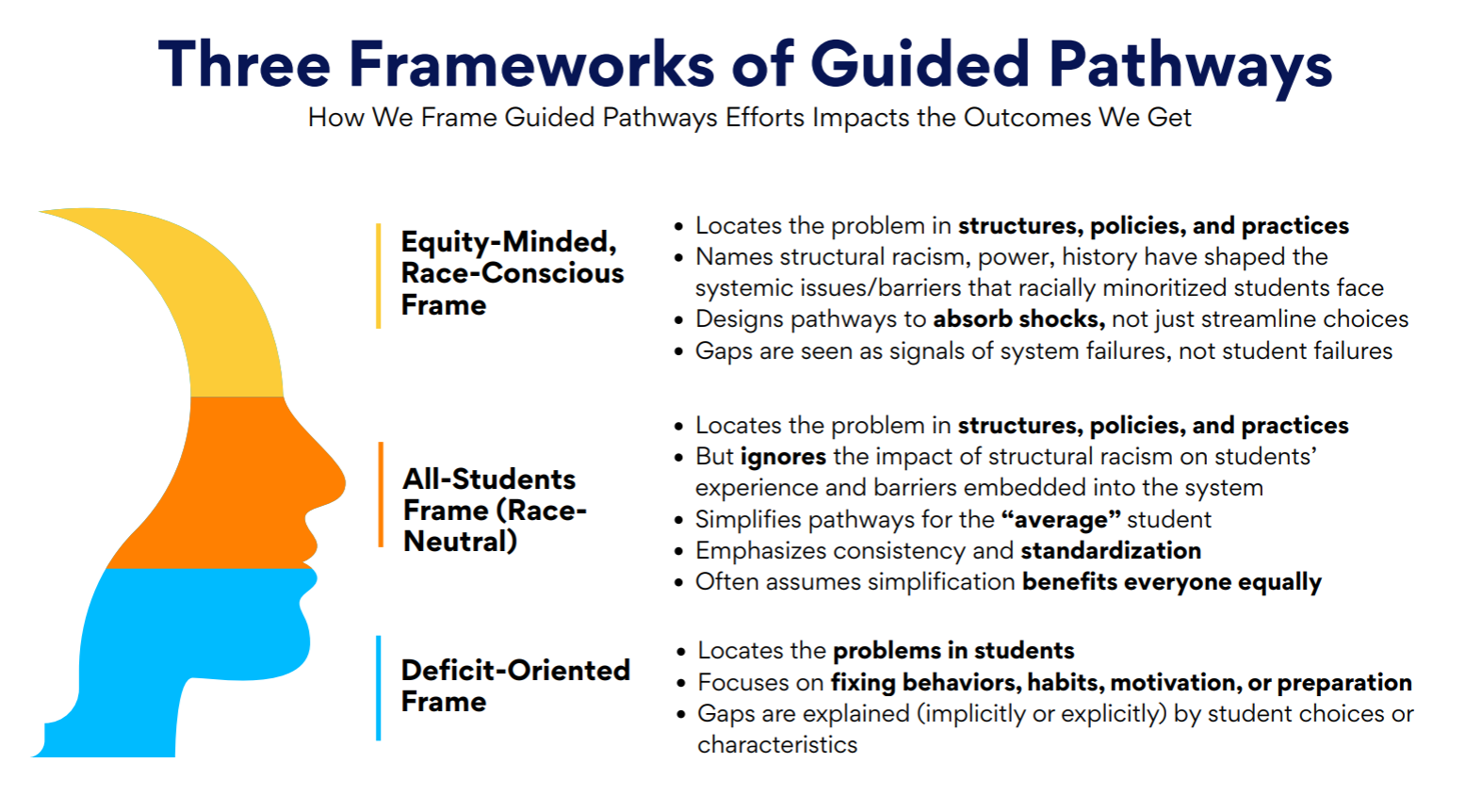
Equity-Minded, Race-Conscious
- Locates the problem in structures, policies, and practices.
- Names structural racism, power, and history that have shaped the systemic issues/barriers that racially minoritized students face.
- Designs pathways to absorb shocks, not just streamline choices.
- Gaps are seen as signals of system failures, not student failures.
All-Students (Race-Neutral)
- Locates the problem in structures, policies, and practices.
- Ignores the impact of structural racism on students' experiences and barriers embedded in the system.
- Simplifies pathways for the "average" student.
- Emphasizes consistency and standardization.
- Often assumes simplification benefits everyone equally.
Deficit-Oriented
- Locates the problems in students.
- Focuses on fixing behaviors, habits, motivation, or preparation.
- Gaps are explained (implicitly or explicitly) by student choices or characteristics.
The Work Thus Far
Starting in 2017, Guided Pathways work focused on moving the college away from a "cafeteria-style" model to a clearer pathways model for students.
Nine Goal Areas
- Program Maps
- Areas of Interest
- Student Support
- Critical and Gateway Courses
- Scheduling/Enrollment
- Student Facing Technology
- Communication and Outreach
- Professional Development
- Campus Community
Campus Programs and Areas
Guided Pathways Initiatives on campus that supported the goals of the redesign:
- Areas of Interest
- Direct Connect
- Embedded Classroom Initiative (ECI)
- Equitizing Gateway Courses (EGC)
- Gateway to Persistence and Success (GPS)
- Peer Navigators
- Program Maps
- Stellic
- Student Success Teams
2025-2026 Guided Pathways Collaborative
In 2025, the Guided Pathways Collaborative was formed to examine the current experience for first-time-in-college students at SMC. The work is outlined in the GP Collaborative page.